
What practices are forming us for the world we are living in?
May 29, 2026
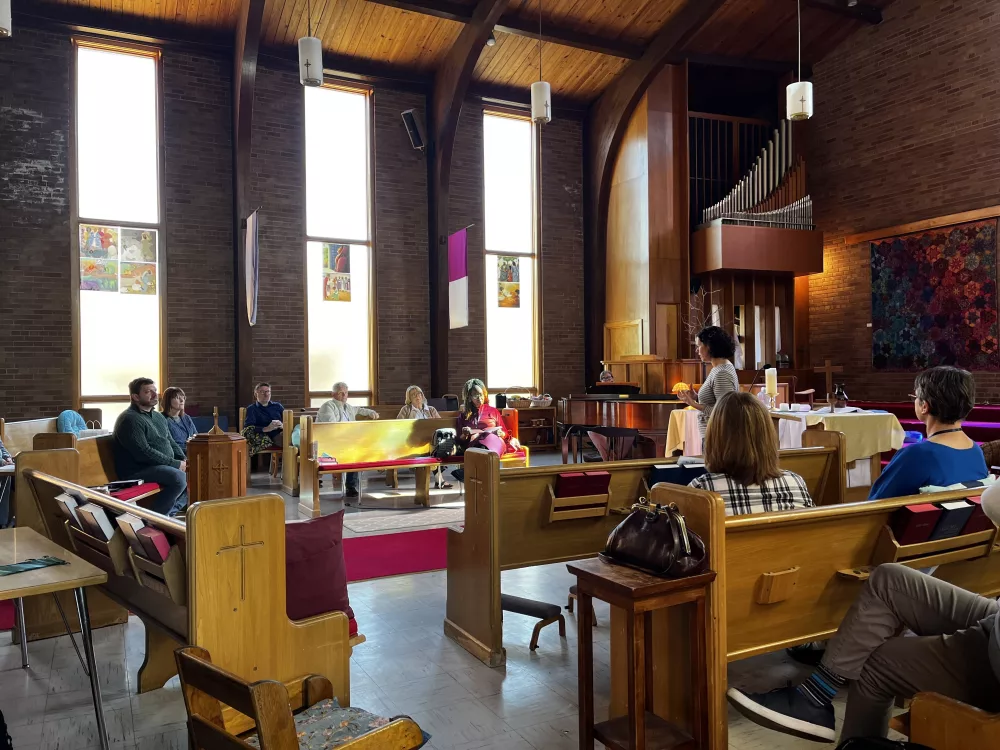
In April, our cohort of District Superintendents traveled to Minneapolis for a learning journey centered on the hard and holy work of justice. The group visited places marked by grief, courage, and witness — including the George Floyd Memorial and the memorial connected to Renée Good — entering into practices of lament, remembrance, and prayerful attention.
Throughout the journey, one theme continued to emerge: Faithful leadership today is not only about what churches do, but about how communities are formed.
At New City Church, Rev. Tyler Sit shared how pastoral leadership in this moment requires preparing communities to respond faithfully during times of moral crisis. Rather than centering ministry around attracting people into church programs, New City Church has cultivated deep partnerships within the neighborhood. Nonprofits and community organizations regularly gather in the church building, transforming the space into a hub of shared life, collaboration, and mutual care. These partnerships not only strengthen the community; they also create sustainable economic support for the congregation’s mission.
The vision is deeply relational and rooted in presence. The church is not standing apart from the community, waiting for people to come in. It is participating in the life of the neighborhood itself.
At Lake Nokomis Presbyterian Church, Rev. Kara Root introduced the group to the congregation’s countercultural practice of Sabbath. The church gathers for traditional worship only two Sundays each month. On alternate weekends, the community gathers on Saturday evenings for contemplative prayer and then intentionally refrains from Sunday programming altogether, practicing Sabbath together as a congregation.
This summer, the church is extending that commitment even further through a communal “Tech Sabbath,” stepping away from digital distractions for several weeks in order to focus more intentionally on relationships, presence, rest, and attention to God.
For many in our cohort, the experience was striking precisely because it challenged so many assumptions about ministry success. In a church culture often shaped by urgency, constant activity, and anxiety about institutional survival, Lake Nokomis is asking a different question: What kind of people are we becoming?
The practice of Sabbath resists the idea that our worth — or the church’s worth — is measured by productivity alone. Instead, it forms people to trust, to notice, to rest, and to belong.
Though Tyler Sit and Kara Root lead in different contexts, both embody a similar conviction: The role of pastoral leadership is not merely to increase attendance or maintain institutions, but to participate with the Holy Spirit in forming people and communities for this moment in history.
Formation happens through practices.
Through shared meals and neighborhood partnerships.
Through lament and witness.
Through contemplative prayer and Sabbath rest.
Through creating communities where people learn how to pay attention — to God, to one another, and to the needs of the world around them.
The Minneapolis learning journey reminds us that the future of the church may depend less on finding the perfect strategy and more on recovering practices that form resilient, compassionate, and courageous people.
Perhaps that is one of the church’s greatest callings in this time: not simply growing larger, but helping people become more deeply rooted in the life of God and more faithfully present to the world God loves.